LCD display failure modes are among the most common challenges engineers face when designing reliable electronic systems. Whether caused by backlight degradation, driver IC faults, or environmental stress, understanding why LCD modules fail is the first step to preventing them. This article covers the root causes, symptoms, and design decisions that affect long-term LCD reliability.
How it works
Key components in an LCD module
A typical LCD module combines several interdependent components. Failure in any one of them can affect the entire display:
LCD glass panel
Driver ICs
Backlight unit (LED)
Flexible circuits (FPC/COF)
Polarizers & optical films
Failure modes
The 5 most common LCD failure types
01
Backlight degradation
LED aging
02
Driver IC failure
Electrical
03
FPC / COF issues
Mechanical
04
LC contamination
Material
05
Polarizer aging
Optical
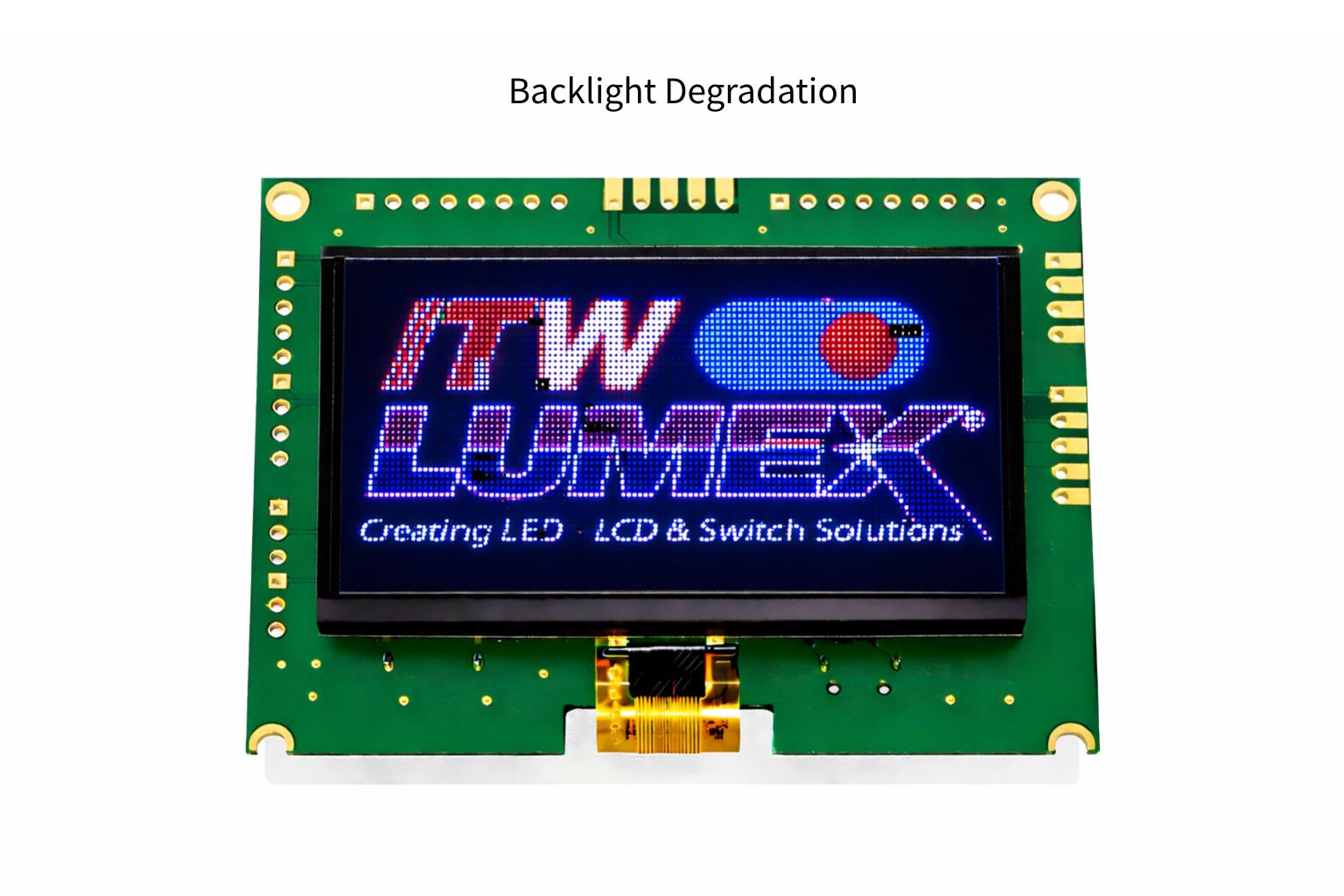
Backlight degradation causes reduced brightness and uneven illumination across the panel.
|
Backlight degradation or failure
LCD modules typically use LED backlighting, which gradually degrades over time due to thermal and electrical stress. This is one of the most frequent end-of-life failure modes.
|
|
Symptoms
Display becomes dim
Uneven brightness across screen
Backlight completely turns off
|
Root causes
Excessive drive current
Poor thermal management
Long operating hours
|
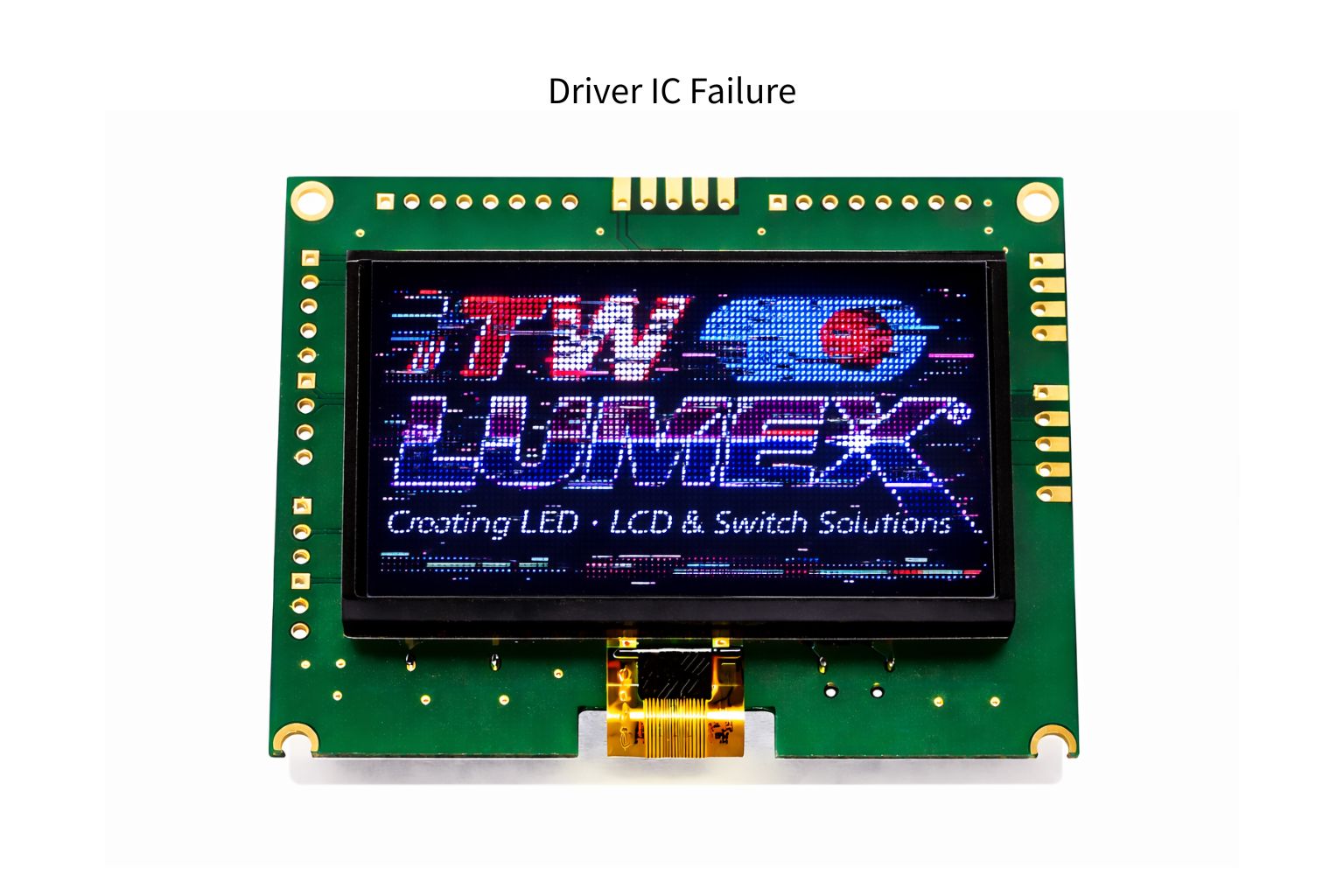
Driver IC failure causes corrupted images, noise patterns, vertical lines, and display artifacts.
|
Driver IC failure
The driver IC controls how each pixel is addressed. When this component fails, the LCD module may display abnormal patterns, noise, or stop updating entirely.
|
|
Symptoms
Vertical or horizontal lines
Partial display loss
Frozen or corrupted images
|
Root causes
Electrical overstress (EOS)
Electrostatic discharge (ESD)
Power sequencing errors
PCB design issues
|
Flexible circuit (FPC / COF) connection issues
LCD modules rely on fine-pitch flexible circuits to connect the glass panel to the controller board. These connections are particularly sensitive to mechanical stress and repeated movement.
|
Symptoms
Missing rows or columns
Flickering sections
Intermittent operation
|
Root causes
Mechanical vibration
Repeated flex cable bending
Weak manufacturing bonding
Connector wear
|
Liquid crystal contamination or leakage
The liquid crystal material can degrade if the panel seal fails or if contamination occurs during manufacturing, causing visible and permanent damage to the active display area.
|
Symptoms
Dark spots or clouding
Uneven contrast
Permanently distorted areas
|
Root causes
Seal failure
Manufacturing contamination
Chemical exposure
Excessive UV radiation
|
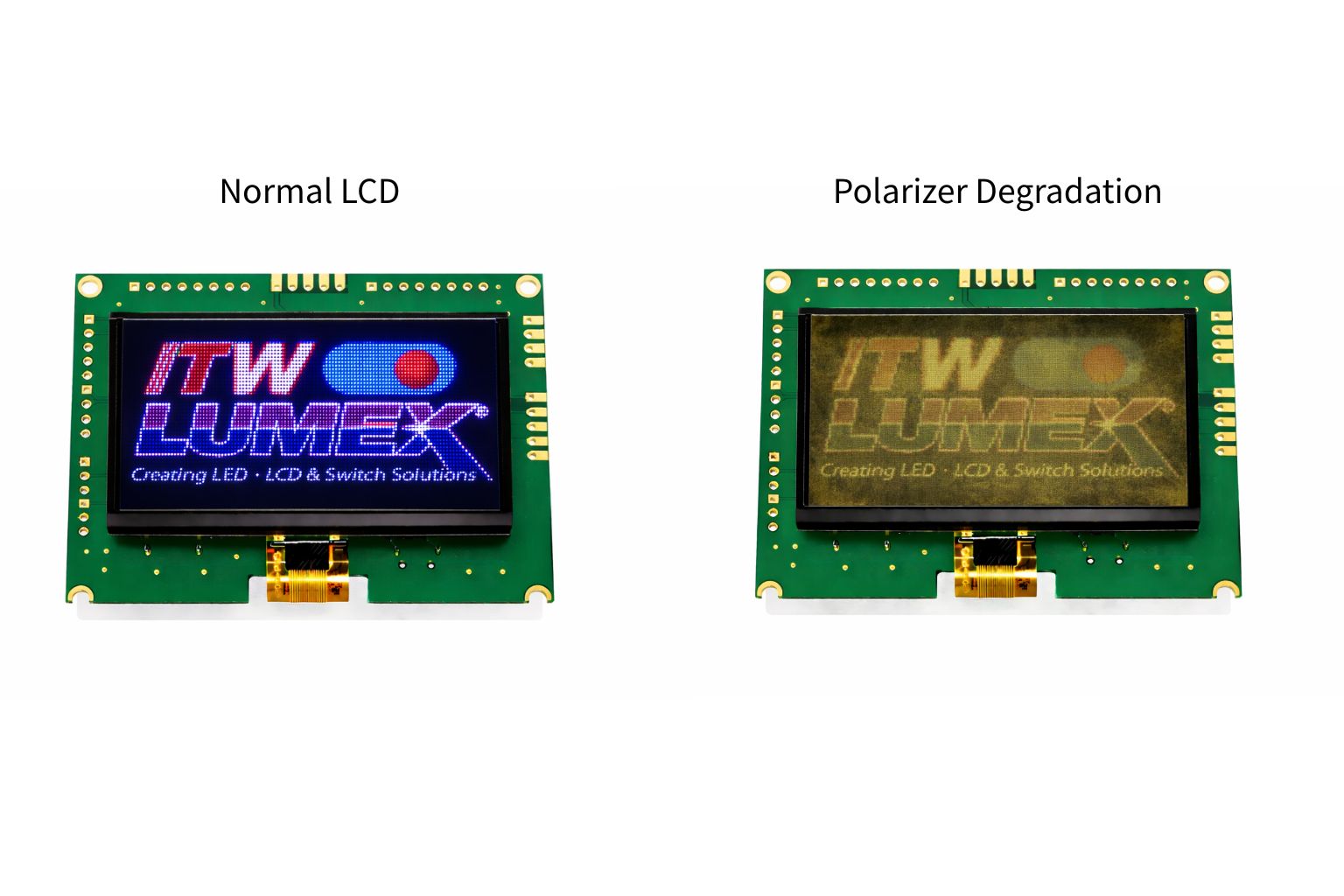
Comparison of a normal LCD (left) vs. polarizer degradation (right) — note the yellowing and contrast loss.
|
Polarizer and optical film aging
LCD panels rely on polarizers and optical films to control light transmission. These materials degrade over time due to heat, UV exposure, or humidity, causing visible color and contrast shifts.
|
|
Symptoms
Reduced contrast
Yellowing of the display
Color shifts
|
Root causes
High temperature environments
Prolonged sunlight exposure
Material aging over time
|
Environmental stress
Factors that accelerate LCD failure
?️
Speeds up LED & material aging
?
Humidity
Damages optical films & bonding
〰️
Vibration
Stresses FPC connections
☀️
UV exposure
Degrades polarizer films
Design guidance
How engineers can improve LCD reliability
|
? Design robust thermal management to protect LEDs and ICs from heat stress
|
⚙️ Implement correct power sequencing procedures during system startup
|
|
?️ Add ESD protection circuits in system-level design to safeguard driver ICs
|
? Use mechanical strain relief on flex cables to prevent connection fatigue
|
Get in touch
Need a reliable LCD solution for your application?
Whether you're troubleshooting an existing display issue or designing a new product from scratch, Lumex's engineering team is ready to help. We offer fully custom LCD configurations and provide tailored display solutions for a wide range of industries and project requirements — from ruggedized environments to high-volume production.